How China came to build the technology everyone uses
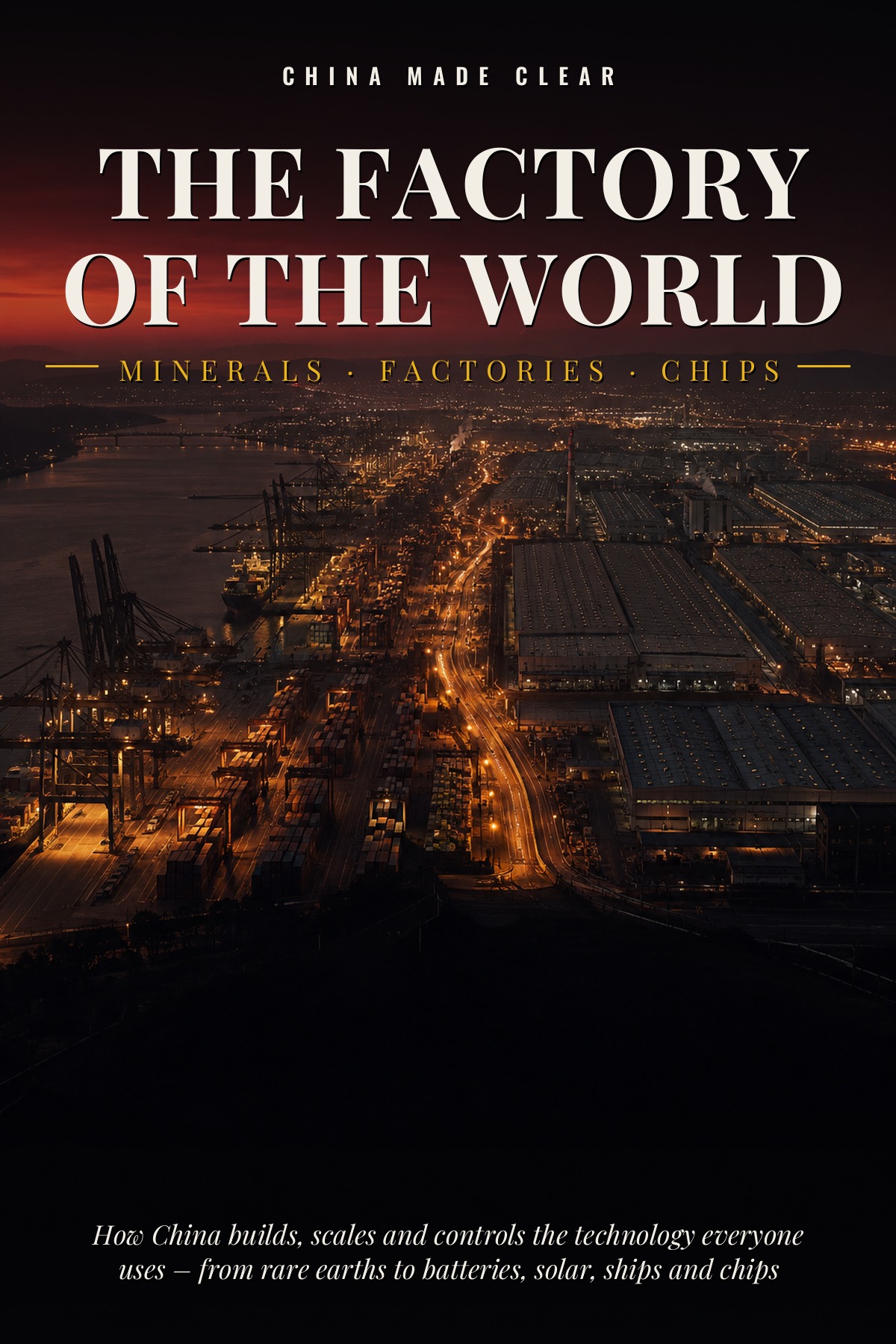
Rare earths, batteries, solar, ships, ports, chips and the yuan: 24 chapters on the mechanisms behind the headlines – and the questions that let you judge the next one yourself.
- Mining share or refining share, claim or measurement, pilot line or volume – the questions that turn a headline into something you can check
- Each industry as a mechanism: why the refinery sits where it sits, how a cluster iterates in days, why overcapacity became a strategy
- Strengths and constraints side by side: demographics, property, debt and export dependence get the same scrutiny as the successes
$19.99 $39.99 one-time payment · instant access
What's inside
Part I – How the Machine Was Built
- Shenzhen, 1980: zones, labor and capital start the machine
- The cluster advantage: every supplier within an hour's drive
- The state as investor: plans, subsidies and provincial rivalry
- Scale as strategy: overcapacity, price wars and thin margins
Part II – Minerals and Materials
- Rare earths: not rare, but refined in one place
- Lithium, cobalt, nickel, graphite: owning the refinery, not the mine
- Gallium, germanium, antimony, tungsten: the export-control toolbox
- Steel, aluminum, copper, polysilicon: bulk materials and their energy
Part III – The Clean-Tech Sweep
- Solar: from German feed-in tariffs to most of the world's capacity
- Batteries: CATL, BYD and the LFP bet
- Electric vehicles: vertical integration, the price war, the export wave
- Wind, grid and nuclear: UHV lines and the build-out pace
Part IV – Ships, Rails, Ports and the Physical Web
- Shipbuilding: to over half of world tonnage
- Ports and terminals: COSCO, Piraeus, Hambantota and the debt debate
- High-speed rail exports: Jakarta–Bandung, Laos, Africa
- The container economy: Shanghai, Ningbo, Shein, Temu, de minimis
Part V – Chips, Software and the Tech Frontier
- Semiconductors: SMIC, 7 nanometers, EUV and export controls
- Telecoms and standards: Huawei, 5G, Beidou versus GPS
- AI and data: DeepSeek, compute limits, open weights
- Robots, drones and space: DJI, robot density, Tiangong
Part VI – Money, Power and What Comes Next
- The yuan and de-dollarization: what has actually changed
- Sanctions and workarounds: the measurable effects
- The weaknesses: demographics, property, debt, export dependence
- Reading the next decade: a checklist for claims versus measurements

Sound familiar?
Headlines without a unit
"China controls 90 percent of rare earths." Ninety percent of what – the ore, the separation, the magnets? Without the step in the chain, the number is a mood, not a fact.
Announcements sold as results
A pilot line becomes a finished industry, a chip on a slide becomes a shipping product. The distance between the two is years – and most announcements never cross it.
Two stories, no mechanism
Either China cheated or China simply out-built everyone. Both contain true sentences, and neither tells you why the refinery, the shipyard or the gigafactory ended up where it did.
„Most of the leverage in this story lives in the difference between mining share and refining share."
Six parts, one machine
How the machine was built
Shenzhen, clusters, the state as investor, scale as strategy.
Minerals and materials
Rare earths, lithium, gallium, steel – and where refining actually happens.
The clean-tech sweep
Solar, batteries, electric vehicles, wind, grid and nuclear.
Ships, rails and ports
Shipbuilding, terminals, high-speed rail exports, the container economy.
Chips and the frontier
Semiconductors, telecoms and standards, AI, robots, drones and space.
Money, power, what comes next
The yuan, sanctions, the real weaknesses, and how to read the next decade.
This is for you if …
You watch the channel
You know the topics from the videos and want the complete, unhurried version with all the numbers – to look things up and check them.
You have money or a career in the picture
Supply chains, tariffs and export controls decide what your industry can buy and sell. You want the mechanism, not a mood.
You are tired of two stories
You have read the cheerleading and the doom and want a book that treats China's strengths and constraints with the same seriousness.
Get the complete book
- The full book: 24 chapters in six parts, 240 pages
- Every industry explained as a mechanism, with orders of magnitude you can check
- The closing checklist: five headline patterns taken apart
- Instant access on any device – phone, tablet, computer, e-reader
PDF ebook · tax included · one-time payment · instant download
Questions this book answers
- Why the country that mines the least rare earths can still stop a magnet factory on another continent
- How a solar module came to cost roughly a tenth of what it did fifteen years ago – and who paid for the learning
- What an export licence for gallium actually did to prices and production, month by month
- Why a Chinese shipyard can quote a hull for less than a rival's steel bill
- What Hambantota's lease really says, and what the debt-trap story gets right and wrong
- How far SMIC can go without EUV – and what the Mate 60 proved and did not prove
- Why DeepSeek mattered more for cost than for capability
- What share of world reserves the yuan holds, and why capital controls are the ceiling
- How shadow fleets and third-country routing work, and where they leak
- Why "collapse" and "unstoppable" are both the wrong base rate
Common questions
Do I need a background in economics or engineering?
No. Part I explains the mechanisms that everything else relies on, with concrete examples. Each later chapter assumes only what came before it.
Is this an investment guide?
No. The book explains industries, supply chains and policy tools and separates measured results from claims and announcements. It gives no buy or sell recommendations.
How current are the figures?
Figures are given as orders of magnitude and ranges with a year and a place, not as daily prices. Where values move quickly – export controls, tariffs, chip rules – the text says so explicitly.
Does it take a side?
It presents China's strengths and its constraints with the same seriousness and names winners and losers only where the evidence supports it. No cheerleading, no doom.
What format do I get?
A PDF in A5 format – readable on phone, tablet, computer and e-reader, and printable.
How do I get access after buying?
Right after checkout, by email with a personal download link.